How do you draw a person in the rain?
Short answer
Drawing a person in the rain requires capturing the interaction between the figure and the environment. Focus on downward-slanting streaks, wet-surface reflections, and body language that conveys discomfort or protection. By combining dynamic line work with careful shading, you create a convincing atmosphere that makes the viewer feel the precipitation.
On this page
How to draw rain effects realistically
To draw rain, you must understand that it is not just a series of lines but a collection of light and shadow. Start by drawing thin, diagonal strokes across your paper to represent the direction of the wind. Vary the length and thickness of these lines to create depth; foreground rain should be longer and more distinct, while background rain appears as a soft, blurry haze.
Avoid drawing perfectly straight, uniform lines, as this makes the rain look like static bars. Instead, use slight variations in pressure to mimic the natural movement of water droplets. You can also use an eraser to pull out highlights within the rain streaks, which adds a sense of luminosity and movement to the scene.
- Sketch the figure first to establish the composition.
- Add diagonal strokes for rain, ensuring they follow a consistent angle.
- Use a kneaded eraser to soften lines in the distance.
- Add small splashes where the rain hits the ground or shoulders.
How to capture body language in the rain
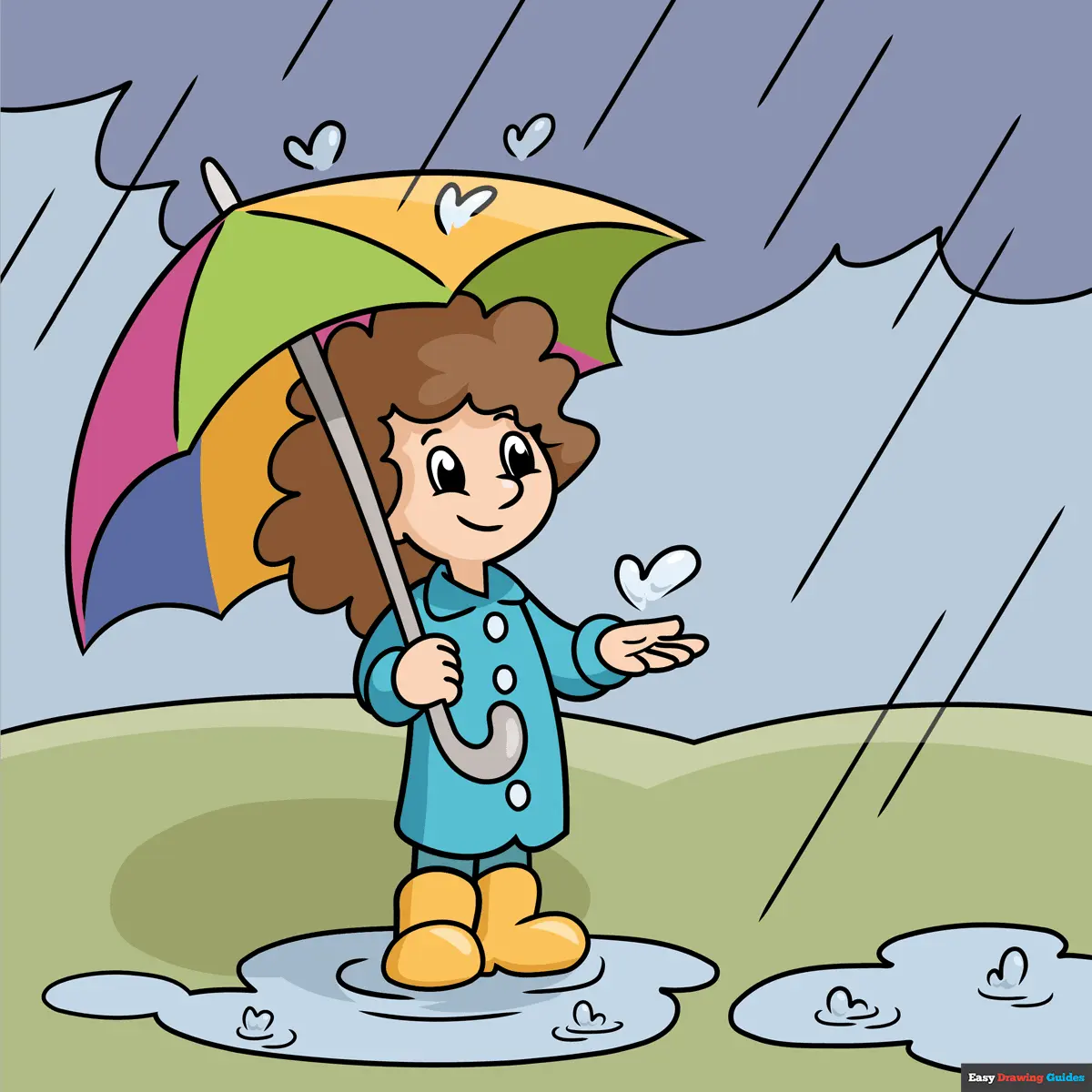
When a person is caught in the rain, their posture naturally shifts to protect them from the elements. Draw the shoulders hunched toward the ears and the head tucked down, as this creates a sense of tension and urgency. If the person is holding an umbrella, ensure their arm is angled to account for the weight and the specific direction of the wind.
Clothes should appear heavy and clingy when wet, which changes the silhouette of the figure. Add darker shading to the folds of fabric to suggest moisture, and draw the edges of garments slightly drooping or dripping. This attention to detail communicates the environmental impact on the character, making the drawing feel more grounded and authentic.
- Hunched shoulders indicate cold and discomfort.
- Clinging fabric suggests the weight of water.
- Tucked-in heads show a desire to shield the face.
- Rapid, hurried strides convey the need to find shelter.
Best tools for drawing rain scenes
Using the right tools can significantly improve the texture of your rain. Graphite pencils are excellent for building up soft, atmospheric layers, while white gel pens or opaque white paint are essential for creating sharp, bright rain streaks against a darker background. A kneaded eraser is vital for lifting graphite to create the illusion of mist or light catching the falling water.
For more advanced artists, charcoal allows for deep, moody blacks that make the rain stand out. If you are working with ink, use a fine-liner for the crisp, foreground rain and a dry brush technique for the background. Experimenting with different paper textures can also help; a slightly toothy paper will catch the graphite in a way that mimics the chaotic nature of a storm.
Why reflections are important in rain
Rain creates wet surfaces that act as mirrors, which is a key element in making a scene feel truly rainy. When drawing a person standing on pavement, include a soft, inverted reflection of their body directly beneath them. This reflection should be slightly distorted or broken up by ripples if the rain is hitting the ground hard.
Lighting in the rain is often diffused, meaning shadows are less sharp and colors are more muted. Use a blender or a soft cloth to smudge the edges of your shadows, which helps simulate the damp, foggy atmosphere of a storm. By focusing on the interplay between the figure and the reflective ground, you ground the character in a believable, three-dimensional space.
Common mistakes when drawing rain
One of the most frequent errors is making the rain lines too dark or too thick, which can clutter the drawing and obscure the subject. Rain should be a subtle overlay rather than a heavy grid. Always consider the light source; if the rain is backlit by a streetlamp, the streaks should be much brighter and more prominent than in a shaded area.
Another mistake is ignoring the impact of the wind on the rain. If the person’s hair or coat is blowing to the left, the rain streaks must also be angled in that same direction. Failing to align these elements creates a visual disconnect that confuses the viewer. Take time to ensure that every environmental detail works in harmony with the physical state of the person you are drawing.
Key facts
- Use diagonal lines to represent falling rain, angling them consistently to show the direction of the wind.
- Draw longer, thinner lines for distant rain and shorter, thicker dashes for rain closer to the viewer.
- Add dark, horizontal reflections on the ground to ground the figure and emphasize the wet environment.
- Use highlights on the shoulders, head, and umbrella to indicate where the rain hits the person.
- Incorporate "splashes" or small dots where raindrops impact surfaces to create a sense of motion.
- Keep the person's clothing slightly darker or more saturated to simulate the appearance of wet fabric.
The bottom line
Drawing a person in the rain requires balancing the figure with atmospheric effects. By using consistent diagonal lines for the weather and adding strategic highlights to represent wet surfaces, you create a believable sense of depth. Focus on how the environment reacts to the rain, such as splashes and reflections, to anchor your subject firmly within the scene while maintaining a clear, dynamic composition throughout.
People also ask
How do I make rain look like it is falling at an angle?
Draw all your rain lines parallel to each other at the same degree of slant. If the wind is blowing from the left, slant the lines toward the right side of your paper.
Should I draw individual raindrops or streaks?
Use streaks for the majority of the rain to suggest speed and continuous falling. Reserve individual dots or splashes only for areas where the rain hits the ground or the person's clothing.
How do I show that a person is wet?
Increase the contrast on the clothing by adding sharp, bright highlights where the fabric catches light. Wet fabric clings to the body, so draw the clothes slightly tighter against the figure’s silhouette.
What is a common mistake when drawing rain?
A frequent error is drawing rain lines that are too thick or dark, which can make the rain look like solid bars. Keep your lines light and varied in length to maintain a sense of transparency and atmosphere.
How do I draw an umbrella effectively?
Treat the umbrella as a simple dome shape that blocks the rain lines above the person. Ensure the rain lines continue on the other side of the umbrella to show the perspective of the storm.
How do I create the effect of puddles?
Draw irregular, flat shapes on the ground near the person's feet. Fill them with a slightly darker tone than the surrounding ground and include distorted reflections of the person to add realism.
This answer was created with the help of AI research tools and reference sources. Spotted an error? Let us know — we correct mistakes quickly. See our editorial policy.