How do you draw a diamond for beginners?
Short answer
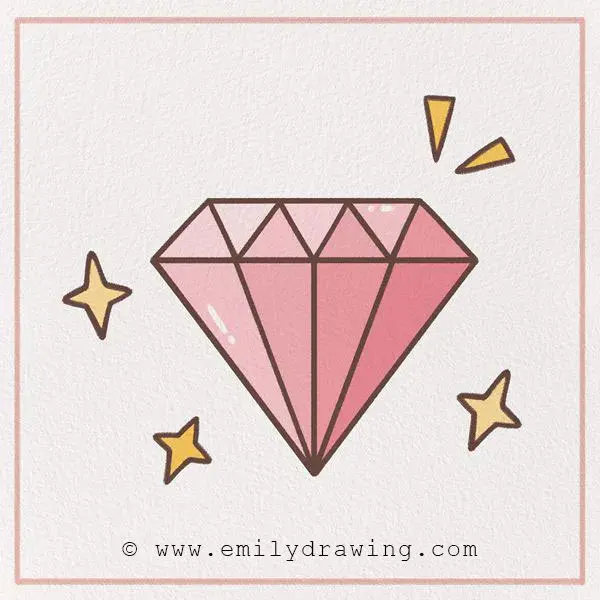
Drawing a diamond is best achieved by sketching a wide, inverted triangle for the top and a narrow, pointed triangle for the bottom. By adding symmetrical facets inside the shape and using light shading, you create a realistic, three-dimensional gemstone effect. This simple geometric approach ensures balance and professional-looking results every time.
On this page
How to draw a diamond step by step
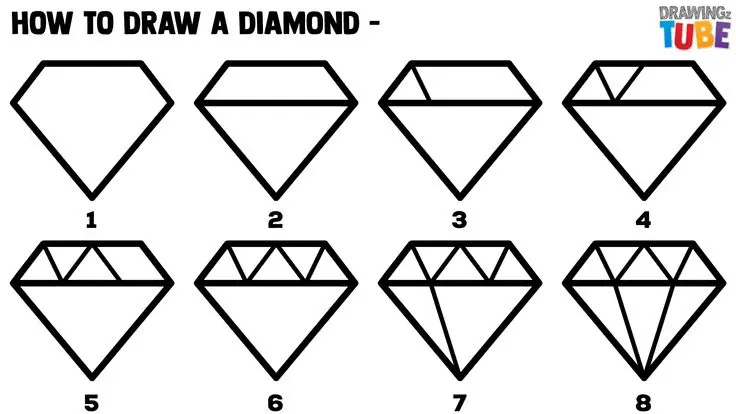
To begin your drawing, start with a horizontal line at the top to serve as the widest part of the diamond, known as the table. From the ends of this line, draw two diagonal lines pointing downward that meet at a sharp center point, creating an inverted triangle. This forms the pavilion, which is the lower portion of the stone that gives it depth.
Once the basic outline is established, you can refine the shape to look more like a faceted gem. Follow these steps to complete the structure:
- Draw a smaller hexagon inside the top horizontal line to represent the table facet.
- Connect the corners of this hexagon to the outer edges of your triangle to create the crown.
- Add several triangular lines radiating from the bottom point upward to create the pavilion facets.
- Ensure all lines are straight and symmetrical to maintain the illusion of a cut stone.
Best tools for drawing diamonds
For beginners, a standard HB graphite pencil is the ideal starting point because it allows for light sketching that can be easily erased. Using a mechanical pencil can also be beneficial if you prefer very thin, precise lines for the facets. Always keep a high-quality white eraser nearby, as geometric shapes often require minor adjustments to achieve perfect symmetry.
When you are ready to add depth, consider using a set of drawing pencils ranging from 2H to 4B. The harder 2H pencils are excellent for the initial light framework, while the softer 4B pencils are perfect for creating dark, dramatic shadows. A blending stump or a piece of soft tissue will help you smooth out the transitions between light and dark areas. Using a ruler is not strictly necessary, but it can help you maintain perfectly straight edges if you struggle with freehand lines.
Why diamond facets look complex
Diamonds appear complex because they are composed of many flat surfaces, or facets, that reflect light in different directions. When drawing, you are essentially mapping out these geometric planes. If you observe a real diamond, you will notice that no two facets are exactly the same size, yet they all fit together to form a cohesive, repeating pattern that covers the entire surface of the stone.
The secret to capturing this complexity is to focus on the angles of the lines rather than the individual shapes. As light hits the diamond, some facets will appear bright white, while others will be deep gray or black depending on the angle of the light source. By varying your pressure, you can mimic the way light bounces off these surfaces. Remember that the facets near the top of the crown are usually wider, while those near the bottom point are much thinner and more elongated.
Common mistakes when drawing diamonds
The most frequent error beginners make is failing to maintain symmetry between the left and right sides of the diamond. If one side is wider or tilted differently than the other, the diamond will look lopsided rather than balanced. To avoid this, try drawing a faint vertical center line down the middle of your paper before you start, using it as a guide to ensure both sides mirror each other.
Another common mistake is applying too much pressure during the initial sketching phase. If you press down hard with your pencil, the indentations will remain on the paper even after you erase your mistakes. Always keep your initial lines very faint so that you can easily clean up the edges once the final shape is determined. Finally, avoid over-complicating the internal facets; start with a few large shapes and only add smaller details once the primary structure looks correct and proportional.
How to shade a diamond for realism
Shading is what transforms a simple line drawing into a convincing, sparkling gemstone. Because diamonds are transparent, they do not have a uniform shadow; instead, they have sharp contrasts where light is trapped or reflected. Identify a single light source before you begin so you know which facets should be highlighted and which should be cast in shadow.
Use a cross-hatching technique to fill in the darker facets, ensuring your pencil strokes follow the direction of the facet edges. Leave the facets that face the light source completely white to simulate the brilliant sparkle of a real diamond. You can also add a small, soft shadow directly beneath the diamond on the surface it is resting on to ground the object. By layering your graphite and carefully blending the edges, you will create a sense of volume that makes the diamond appear to pop off the page.
Key facts
- A standard diamond drawing typically follows a "kite" shape with a pointed bottom and a flat top.
- Begin by drawing a wide, upside-down triangle for the top half, known as the crown.
- Add a smaller, inverted triangle at the bottom to represent the pavilion, which gives the diamond its depth.
- Draw a horizontal line across the widest part of the shape to define the table, or the flat top surface.
- Connect the center point of the table to the bottom tip of the diamond with several V-shaped lines to create facets.
- Use a ruler to ensure your outer lines are perfectly straight, as diamonds are defined by precise geometric symmetry.
The bottom line
Drawing a diamond is an exercise in geometric precision rather than freehand sketching. By focusing on a symmetrical kite shape and adding carefully placed internal lines that converge at a single point, you create the illusion of depth. Remember to use a ruler for clean edges and apply varied shading to distinguish the facets, which ultimately transforms a simple two-dimensional outline into a convincing, brilliant gemstone.
People also ask
What is the most common mistake when drawing a diamond?
The most frequent error is neglecting symmetry, which makes the diamond look lopsided or organic rather than crystalline. Always use a straightedge to ensure the left and right sides mirror each other perfectly.
Should I use shading to make the diamond look real?
Yes, shading is essential for creating a three-dimensional effect. Focus on leaving the top facets very light while darkening the bottom facets to simulate how light refracts through a gemstone.
How many facets should I draw inside the diamond?
For a beginner, drawing between six and eight main internal lines is sufficient. Adding too many lines can clutter the drawing and make it difficult to manage your shading.
Can I draw a diamond without a ruler?
While possible, it is difficult to achieve the sharp, clean edges required for a professional look. A ruler or any straight-edged object will significantly improve the geometric accuracy of your sketch.
What type of pencil is best for this drawing?
An HB pencil is ideal for the initial light outline, while a 2B or 4B pencil is better for adding the dark, dramatic shadows. This range allows you to create depth without smudging your work.
Why do my diamond drawings look like flat triangles?
This usually happens because the internal facet lines are not angled correctly toward the center point. Ensure your internal lines converge at the bottom tip to create the illusion of a deep, sparkling stone.
This answer was created with the help of AI research tools and reference sources. Spotted an error? Let us know — we correct mistakes quickly. See our editorial policy.
