What is Mark Rothko known for?
Short answer
Mark Rothko is best known as a pioneer of Abstract Expressionism, specifically for his large-scale "color field" paintings. These iconic works feature soft-edged, luminous rectangular forms stacked vertically on canvas. He aimed to express profound human emotions—such as tragedy, ecstasy, and doom—through color and scale rather than representational figures.
On this page
What defines a Mark Rothko painting?
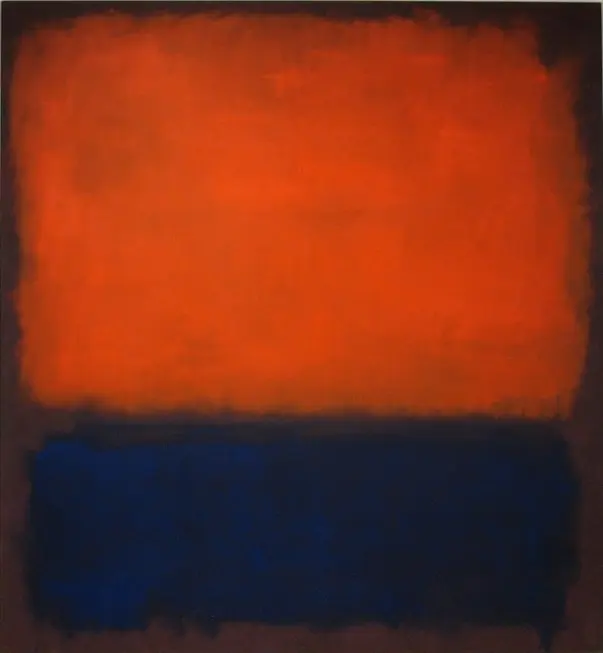
Rothko’s signature style emerged in the late 1940s, moving away from his earlier surrealist-influenced figures. His mature works consist of two or three rectangular blocks of color hovering against a contrasting background. These shapes are not hard-edged; instead, the edges are feathered and blurred, creating an optical effect where the colors seem to pulse or vibrate against one another.
The artist applied thin layers of oil paint in a technique resembling watercolor washes, allowing light to reflect off the canvas surface. This method gives his paintings a glowing, ethereal quality that changes depending on the viewer's distance and the ambient light in the room. By removing all recognizable objects, Rothko forced the viewer to confront the raw power of color as a psychological tool.
Key characteristics of his mature style include:
- Large-scale canvases designed to envelop the viewer’s field of vision.
- Vertical arrangements of rectangular blocks with soft, permeable edges.
- Deep, saturated pigments that create a sense of infinite depth.
- A deliberate lack of titles or narrative cues to prevent distraction.
Why did Rothko paint in such large formats?
Rothko believed that small paintings were intimate and domestic, whereas his large canvases were intended to be communal and transcendent. He famously stated that he wanted to paint "big" to be intimate, meaning he wanted the viewer to feel physically surrounded by the work. By standing close to a massive canvas, the viewer loses their peripheral vision, effectively "entering" the painting’s color space.
This scale was intended to induce a meditative or even religious experience. Rothko wanted his work to function like a sanctuary, stripping away the distractions of the modern world. He often requested that his paintings be hung low and in dimly lit rooms, ensuring that the viewer felt dwarfed by the color fields. This physical immersion was central to his goal of evoking basic human emotions.
How to appreciate Rothko’s work as a beginner
Viewing a Rothko painting requires patience and a willingness to set aside the need for a literal subject. Many newcomers feel confused by the simplicity of the compositions, but the goal is to observe the emotional resonance of the colors rather than searching for a hidden meaning. It is a subjective experience that relies entirely on your personal reaction to the hues.
To get the most out of your viewing experience, follow these steps:
- Approach the canvas slowly and stand at a distance of about 18 to 24 inches.
- Allow your eyes to adjust to the subtle shifts in tone and light within the color blocks.
- Breathe steadily and let the colors occupy your entire field of vision for several minutes.
- Observe how your mood shifts as you focus on the interaction between the different layers of paint.
- Move back and forth to see how the painting’s "vibration" changes from a distance versus up close.
Common mistakes when viewing abstract art
One of the most common errors is assuming that a painting must be "about" something specific, such as a landscape or a person. When viewers look for a narrative, they often miss the visceral impact of the art. Rothko’s work is not a puzzle to be solved; it is an environment to be felt. Trying to intellectualize the process often blocks the emotional connection.
Another mistake is viewing these works exclusively through digital images or prints. Because Rothko used layered glazes and specific textures, the physical presence of the paint is critical to the work’s success. A photograph cannot capture the way light interacts with the layers of oil or the true scale of the canvas. To truly understand his work, one must experience the original paintings in a gallery setting.
What is the legacy of the Rothko Chapel?
The Rothko Chapel in Houston, Texas, represents the culmination of the artist’s lifelong ambition to create a space for spiritual reflection. Opened in 1971, the building houses fourteen monumental black-on-maroon paintings. These works are arguably his most somber and meditative, reflecting his belief that art should provide a space for contemplation regardless of religious affiliation.
The chapel serves as a non-denominational site for meditation and social justice, fulfilling Rothko’s desire to create a universal human experience. It is the ultimate expression of his belief that art could transcend the limitations of language and culture. By creating an environment where color and light dictate the atmosphere, Rothko achieved his goal of connecting with the viewer on a profound, spiritual level that remains influential today.
Key facts
- Mark Rothko (1903–1970) was a leading figure in the Abstract Expressionist movement, famous for his large-scale "color field" paintings.
- His signature style features rectangular forms of glowing, layered color that appear to hover on the canvas.
- He intentionally painted his canvases on a massive scale to create an intimate, immersive experience for the viewer.
- To appreciate his work, stand about 18 inches away from the canvas to allow the colors to fill your entire field of vision.
- Avoid looking for recognizable objects or symbols in his paintings, as Rothko intended his work to express basic human emotions like tragedy and ecstasy.
- Do not view his paintings in bright, harsh lighting; they are designed to be seen in dim, contemplative spaces to reveal subtle shifts in tone.
The bottom line
Mark Rothko remains one of the most influential painters of the modern era, celebrated for his ability to translate complex human emotions into pure color. By stripping away traditional subjects, he created immersive, meditative environments that challenge viewers to look inward. His legacy persists through his iconic color field paintings, which continue to define the power of abstract art to evoke profound, wordless spiritual responses.
People also ask
Why are Rothko's paintings so expensive?
His works are considered masterpieces of 20th-century art, representing a pivotal shift toward pure emotional expression. Because he produced a finite number of major canvases, high demand from museums and private collectors drives prices into the tens of millions.
Did Rothko intend for his paintings to be religious?
While he was not a strictly religious man, Rothko viewed his art as a spiritual experience. He often compared the emotional intensity of his work to the feeling of being in a cathedral or a place of deep meditation.
What is the significance of the Rothko Chapel?
Located in Houston, Texas, this non-denominational sanctuary houses 14 of his monumental black-toned canvases. It serves as a permanent, meditative environment designed specifically to house his art in a unified, architectural setting.
How did Rothko apply paint to his canvases?
He used thin, translucent washes of oil paint applied in multiple layers. This technique creates a luminous, vibrating effect that makes the colors seem as though they are glowing from within the fabric.
What was Rothko’s relationship with the Abstract Expressionists?
He was a central member of the New York School alongside artists like Jackson Pollock and Willem de Kooning. However, he eventually distanced himself from the group, rejecting the label of "abstract" because he believed his work was rooted in human experience.
Why did Rothko paint such large canvases?
He believed that a small painting could not contain the vast, universal emotions he wanted to convey. By painting on a human scale, he forced the viewer to confront the work physically rather than just observing it from a distance.
This answer was created with the help of AI research tools and reference sources. Spotted an error? Let us know — we correct mistakes quickly. See our editorial policy.