How do you draw a black panther?
Short answer
Drawing a black panther requires focusing on muscular anatomy and light reflection rather than just dark pigment. Begin by sketching the feline’s powerful, low-slung frame using geometric shapes. Layer deep shadows while preserving highlights along the spine and shoulders to convey the sleek, glossy texture of the animal's signature melanistic coat.
On this page
How to sketch the basic anatomy of a panther
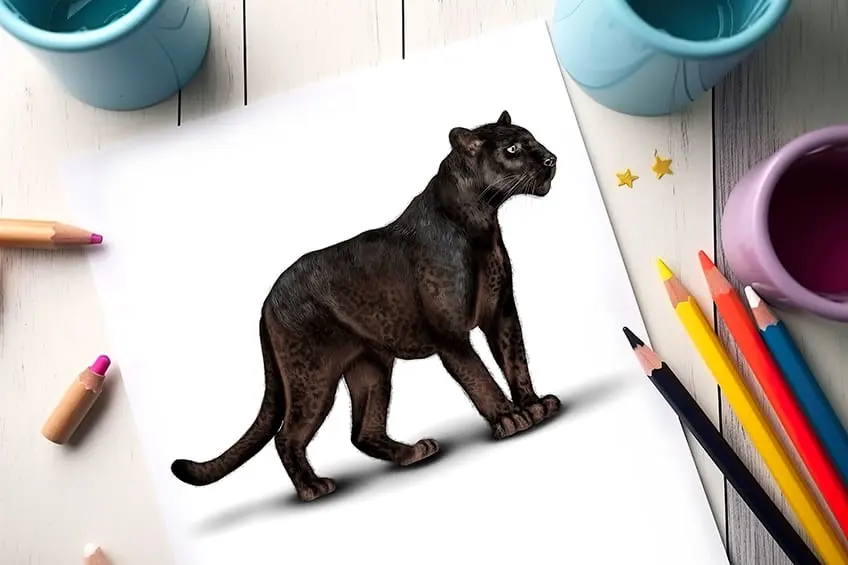
A black panther is biologically a melanistic leopard or jaguar. To draw one accurately, you must emphasize its heavy, muscular build compared to a lighter-framed cheetah. Start by sketching three primary circles: one for the head, a larger one for the chest, and a smaller one for the hindquarters. Connect these with a curved spine line to establish the characteristic prowling posture.
Keep your initial lines light, as you will need to erase them later. Focus on the low center of gravity; panthers carry their weight close to the ground. Ensure the neck is thick and powerful, as it supports the weight of the head and heavy jaw. Use these steps to establish your foundation:
- Draw an oval for the skull, placing it slightly lower than the chest circle.
- Sketch the shoulder blades as prominent shapes, as these are often visible through the fur.
- Define the tail length, which should be nearly as long as the body to provide balance.
Best drawing techniques for fur texture
Capturing the look of a black panther is challenging because the fur is dense and dark. Avoid using a solid black block of color, which makes the drawing look flat. Instead, use a range of graphite or charcoal pressures to create depth. Use short, directional strokes that follow the flow of the muscle groups to suggest the direction of the hair growth.
When working with shadows, start with a mid-tone gray and gradually build up to the darkest areas. This layering process prevents the paper from becoming overworked or muddy. Focus your darkest values in the recessed areas, such as under the belly and inside the ears. Remember that even in deep shadow, the panther's coat will have subtle shifts in tone. Use a kneaded eraser to lift small areas of graphite, creating the illusion of individual hairs catching the light.
How to render light and reflections on dark fur
The secret to a realistic black panther is the highlight. Because the fur is sleek, it reflects light similarly to a polished surface. Identify where your light source is located and apply bright, sharp highlights along the top of the back, the bridge of the nose, and the edges of the limbs. These highlights define the animal's volume against the background.
Observe how light interacts with the panther's form:
- Use a white charcoal pencil or a sharp eraser to create thin, crisp lines of reflected light.
- Keep highlights concentrated on the highest points of the muscles to emphasize their strength.
- Vary the intensity of the highlights; the brightest points should be on the areas closest to the light source.
- Soften the edges of your highlights slightly where the light transitions into the mid-tones of the coat.
How to draw the face and eyes
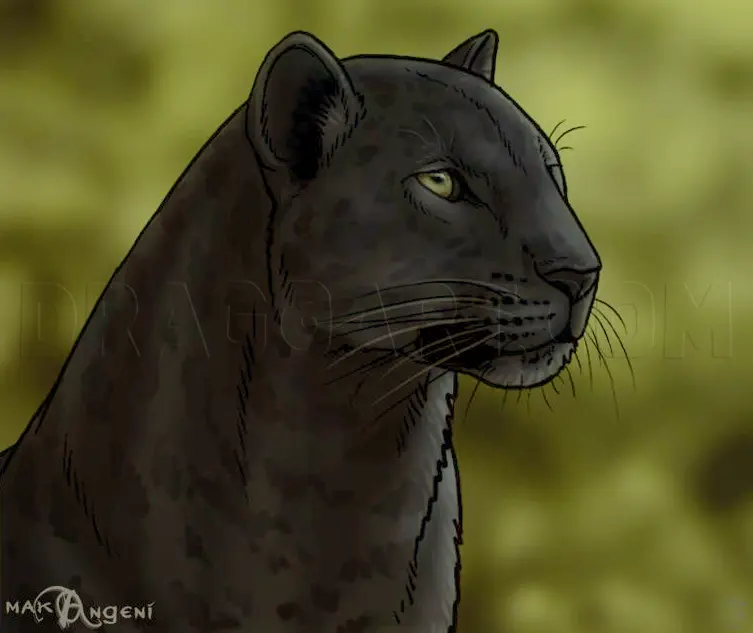
The eyes are the focal point of any animal portrait. For a panther, the eyes should be a piercing, luminous green or gold, which provides a striking contrast to the dark fur. Draw the pupils as vertical slits, which are characteristic of large cats, to add a sense of intensity and predatory focus. Ensure the eyes are set deep within the skull to maintain the panther's intense expression.
When drawing the muzzle, pay attention to the whiskers and the texture of the nose. The nose should be dark but possess a subtle, leather-like texture. Use small, stippled dots to suggest the whisker follicles. Keep the mouth line simple and tight, as a panther’s expression is usually neutral or focused rather than overtly aggressive. If you choose to show teeth, ensure they are sharp and well-defined, but keep the gums dark to maintain the overall monochromatic aesthetic of the animal.
Common mistakes when drawing black panthers
One of the most frequent errors is ignoring the underlying skeletal structure. Beginners often draw the panther as a shapeless blob of black, forgetting that the muscles and bones must be visible beneath the fur. If the anatomy is incorrect, the panther will look like a domestic cat or a cartoon creature rather than a powerful predator. Always check your proportions against reference photos before finalizing your shading.
Another common mistake is failing to create a sufficient range of values. If you use only the darkest pencil in your kit, the drawing will lack dimension. You must utilize the full spectrum of grays, from light silver to deep charcoal, to create the illusion of three-dimensional form. Finally, avoid drawing individual hairs everywhere; this makes the coat look wiry rather than sleek. Focus on the overall mass and shape of the fur, only adding individual hair details at the edges where the panther meets the background.
Key facts
- A black panther is not a distinct species, but a melanistic color variant of a leopard or a jaguar.
- Focus on the muscular, low-slung silhouette, as these cats are built for power and stealth.
- The coat is not solid black; under bright light, you can still see the faint outline of rosettes.
- Use a variety of dark tones—charcoal, deep indigo, and midnight blue—rather than just pure black to create depth.
- Highlight the eyes, which are typically a piercing, luminous yellow or green, to provide a focal point.
- Keep the anatomy fluid; these animals are apex predators known for their grace and coiled tension.
The bottom line
Drawing a black panther requires moving beyond simple black shading to capture the complex interplay of light and shadow on dark fur. By emphasizing muscular anatomy, subtle variations in dark tones, and the piercing intensity of the eyes, you can create a lifelike representation. Remember that the panther is a powerful, graceful predator, and your drawing should reflect that inherent tension and feline elegance.
People also ask
Is a black panther a separate animal from a leopard?
No, a black panther is simply a leopard or jaguar with a genetic condition called melanism. This causes an excess of black pigment in their fur, though their underlying coat patterns remain present.
What is the most common mistake when drawing a panther?
Many artists make the mistake of using only flat black ink or pencil. This makes the animal look like a silhouette, losing the muscle definition and the subtle texture of the fur.
How do I make the fur look realistic?
Use short, directional strokes that follow the contours of the muscles. Leave small gaps or use lighter grey highlights to suggest where light hits the fur.
Should I draw the rosettes on a black panther?
Yes, adding very faint, ghost-like rosettes in a slightly lighter shade of dark grey adds significant realism. They should only be visible upon close inspection or under specific lighting.
What is the best way to capture the panther's gaze?
Focus on the contrast between the dark face and the bright, reflective iris. A sharp white highlight in the pupil gives the eye a sense of life and intensity.
How do I draw the panther’s body shape accurately?
Study the skeletal structure of a large cat, focusing on the heavy shoulders and the long, powerful tail. A common error is making the legs too thin; they must look sturdy and muscular.
This answer was created with the help of AI research tools and reference sources. Spotted an error? Let us know — we correct mistakes quickly. See our editorial policy.