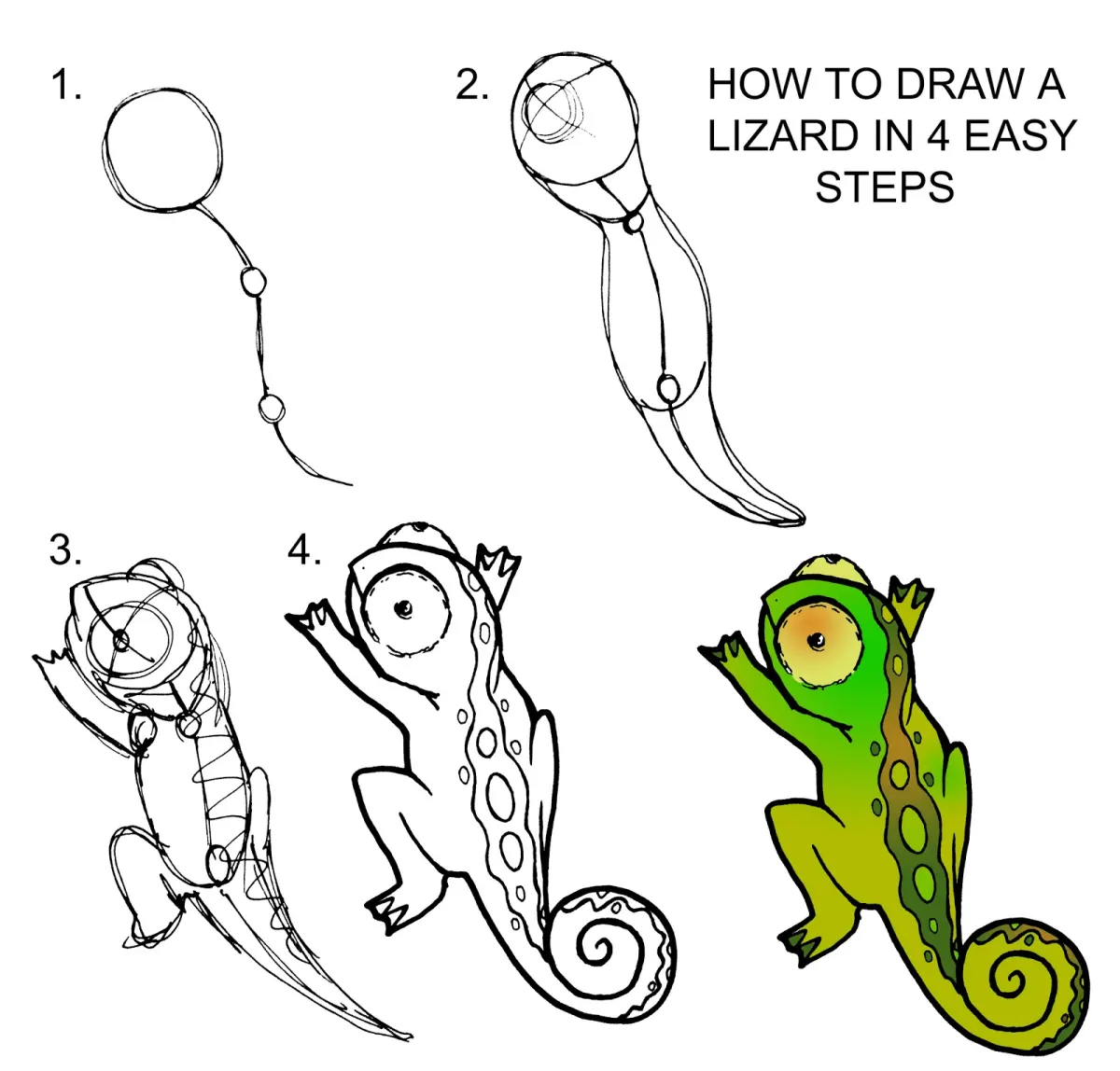
What is the easiest way to draw a chameleon?
Short answer
The easiest way to draw a chameleon is to simplify its anatomy into a series of interconnected ovals and a coiled tail. By focusing on the characteristic "S" curve of the spine and the distinct turret-like eyes, you can capture the animal's recognizable silhouette before adding texture and color details.
On this page
How to draw a chameleon step by step
To begin your drawing, focus on the basic skeletal structure rather than individual scales. Start by sketching a large oval for the body and a smaller circle for the head. Connect these with a curved line that represents the spine, extending it into a long, tight spiral for the tail. This basic framework ensures your chameleon maintains its natural, curled posture.
Once the skeleton is established, refine the outlines to create the animal's unique shape. Chameleons have a distinct crest on their heads and bulky, rounded limbs. Follow these steps to build the form:
- Draw the turret-like eyes as two small circles on the head.
- Add the legs by drawing "Z" shapes that connect to the body.
- Thicken the tail, making it wider at the base and tapering it to a fine point.
- Sketch the feet with two distinct toes on each side, resembling a pincer.
Best drawing techniques for beginners
When starting out, use light graphite pencils like an HB or 2B to keep your initial marks faint. This allows you to erase and adjust the proportions of the body without damaging the paper. Focus on the "S" curve of the back, as this is the most defining feature of a resting chameleon. Avoid pressing too hard, as you will need to layer textures over these guidelines later.
After the outline is set, move on to defining the texture of the skin. Chameleons are known for their bumpy, granular skin, which can be represented by small, irregular dots or clusters of circles. You do not need to draw every single scale; instead, concentrate the detail along the edges of the body and the top of the head. This technique, known as suggestion, creates the illusion of complexity without requiring you to spend hours on repetitive patterns.
Why chameleons are unique to draw
Chameleons possess anatomy that differs significantly from other lizards, primarily due to their specialized adaptations for arboreal life. Their eyes move independently, which you can represent by placing the pupils in different corners of the eye sockets. This adds a sense of personality and realism to your drawing that helps the viewer understand the creature's alert nature.
Their feet are also highly specialized, known as zygodactylous feet. These are arranged into two opposing groups of toes that act like a clamp for gripping branches. When drawing these, ensure you emphasize the pincer-like grip, as this is a key biological marker of the species. Understanding these functional features makes the drawing process more intuitive, as you are not just copying shapes but depicting a creature designed for a specific environment.
Common mistakes when drawing chameleons
One of the most frequent errors is making the body too straight or rigid. Chameleons are almost never found in a completely linear position; they are constantly curving their bodies to navigate twigs and leaves. If your drawing looks stiff, re-evaluate the spine line. Ensure the tail has a tight, circular coil, as this is a primary defensive and balancing mechanism for the animal in the wild.
Another common mistake involves the proportions of the head. Beginners often draw the head too small or too flat. Chameleons typically have a high, helmet-like casque on the back of their skulls. By exaggerating this feature slightly, you immediately make the drawing more recognizable. Additionally, avoid drawing the legs as straight tubes; they should always have a noticeable bend at the joints to reflect the way the animal stalks its prey slowly and deliberately.
How to add color and personality
Adding color is the final stage that brings the drawing to life. While chameleons are famous for their color-changing abilities, you should start with a base layer of greens, yellows, or browns. Use a stippling technique—applying small dots of color—to mimic the texture of their skin. This prevents the drawing from looking flat and adds a sense of depth that a solid wash of color cannot achieve.
To make your chameleon stand out, consider the following artistic choices:
- Use contrasting colors for the eyes to make them pop against the body.
- Add highlights on the top of the crest and the back to suggest a light source.
- Incorporate a small branch or leaf for the chameleon to grip, which contextualizes the drawing.
- Keep the background simple to ensure the viewer's eye remains focused on the intricate details of the lizard's form.
By following these steps and focusing on the characteristic anatomy, you can create a professional-looking illustration of this fascinating reptile with relative ease.
Key facts
- Chameleons are defined by their zygodactylous feet, which have two toes pointing forward and three pointing backward for gripping branches.
- Start your drawing with a large "S" curve to represent the spine, as chameleons frequently coil their tails.
- The eyes of a chameleon are conical and move independently; draw them as two distinct, bulging circles on the sides of the head.
- Use a series of small, overlapping ovals to create the texture of the granular scales rather than drawing individual squares.
- A chameleon's tongue can be as long as its entire body; draw it as a thin, sticky-looking line extending from the mouth.
- Keep the body shape bulky and arched, as chameleons possess a distinct dorsal crest that runs along their backs.
The bottom line
Drawing a chameleon is an exercise in capturing unique, exaggerated anatomy rather than perfect realism. By focusing on the distinctive "S" curve of the spine, the independent turret-like eyes, and the specialized zygodactylous feet, you can create a recognizable figure. Avoid rigid, uniform scales and instead prioritize the creature’s bulky silhouette and expressive posture to bring your drawing to life with character and anatomical accuracy.
People also ask
Why do chameleons change color?
Chameleons change color primarily to regulate their body temperature and to communicate their intentions to other chameleons. They use specialized cells called chromatophores to shift pigments and structural colors based on their mood or environment.
How many toes does a chameleon have?
Chameleons have five toes on each foot, but they are arranged in two opposing bundles. This unique anatomy allows them to grasp narrow branches securely while moving through trees.
Do all chameleons have curly tails?
Most chameleon species have prehensile tails that can curl tightly, though some ground-dwelling species have shorter, stiffer tails. When drawing, a curled tail is the most recognizable feature of the animal.
What is the most common mistake when drawing a chameleon?
The most frequent error is drawing the eyes too close together or making the body too flat. Chameleons have wide, turret-like eyes and a laterally compressed body shape that looks tall and narrow from the front.
How do I draw the texture of the skin?
Avoid drawing a grid of scales, which looks artificial. Instead, use varied, loose circular marks to suggest the bumpy, irregular skin texture found on most species.
Are chameleons difficult to draw compared to other lizards?
Chameleons are often easier to draw because their distinct, exaggerated features like the casque on the head and the curled tail provide clear structural landmarks. These unique shapes make them highly recognizable even with a simplified sketch.
This answer was created with the help of AI research tools and reference sources. Spotted an error? Let us know — we correct mistakes quickly. See our editorial policy.