Why are my drawings crooked?
Short answer
Drawings often appear crooked because of human physiological limitations, specifically the way our eyes and hands coordinate on a flat surface. Most artists naturally favor one side of their body, causing a consistent tilt in line work. Additionally, improper posture, paper orientation, and a lack of structural guidelines frequently distort spatial perception.
On this page
Why drawings look crooked
The primary reason for crooked drawings is the arc of the human arm. When you draw, your hand naturally pivots from the wrist or elbow, creating a slight curve rather than a perfectly straight line. Because your eyes are positioned side-by-side, your brain perceives horizontal and vertical lines differently depending on your viewing angle. If your head is tilted even slightly, your brain compensates by adjusting your perception of the horizon, leading to skewed results.
Furthermore, most people possess a dominant eye and a dominant hand, which can cause a "parallax effect" while sketching. If you are sitting at an angle to your paper, your perspective of the center point shifts. This distortion is compounded if the paper is not squared to your body or the desk edge. Over time, these small, unconscious adjustments become muscle memory, making it difficult to recognize that your work is leaning until you step back and view it from a distance.
How to fix crooked drawings
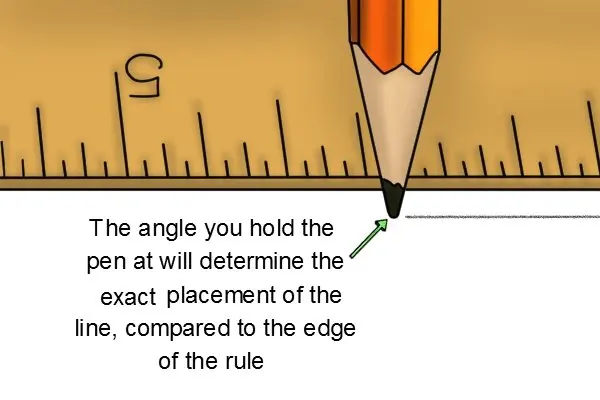
To correct alignment issues, you must rely on external tools rather than your eyes alone. Using a T-square, a ruler, or a drafting triangle provides a physical reference for true vertical and horizontal axes. Before you begin a detailed sketch, lightly mark these axes on your paper to serve as a guide. If you do not have professional tools, you can use the edge of your drawing board or a simple piece of string weighted with a coin to create a plumb line.
- Tape your paper down firmly to ensure it remains stationary throughout the process.
- Use a T-square or a long ruler to draw faint, light guidelines across the page.
- Periodically rotate your paper 180 degrees to force your brain to see the drawing from a new perspective.
- Hold your drawing up to a mirror; the reflection will instantly highlight any lopsided proportions or tilted elements.
Best habits for straight lines
Developing consistency requires intentional physical habits that stabilize your drawing environment. Start by adjusting your chair so that your chest is centered with the middle of your paper. If you are hunched over or leaning to one side, your drawings will inevitably lean in the opposite direction to compensate for your body's posture. Keeping your shoulders square with the table is the most effective way to maintain a neutral perspective.
You should also practice drawing lines from different directions to counteract your natural bias. Many artists find that they can draw a straight vertical line easily but struggle with horizontal ones. By consciously rotating the paper to align the stroke with your natural arm movement, you can maintain better control. Consistent practice with these techniques will eventually retrain your hand to execute lines that align with the intended geometry of your composition.
Common mistakes when sketching
Many beginners fail to account for how their viewing angle changes as they progress through a drawing. A common mistake is failing to step back from the work; when you are too close to the paper, your field of vision is restricted, making it impossible to judge the overall balance. Another error is drawing exclusively from the wrist, which limits your range of motion and encourages curved, shaky lines. Instead, try to engage your entire arm, including the shoulder, to create longer and more stable strokes.
- Ignoring the edges of the paper as a frame of reference.
- Relying on your eyes to "eyeball" symmetry instead of using measurement tools.
- Keeping the paper loose, allowing it to shift subtly during the drawing process.
- Failing to check the alignment of your sketch against the horizon line at regular intervals.
- Working on a surface that is tilted or uneven.
How to improve spatial perception
Improving your spatial perception is a long-term endeavor that involves training your brain to ignore its inherent biases. Start by sketching simple geometric shapes like squares and circles, focusing entirely on their alignment rather than the final illustration. Use a grid overlay to check your work; this helps you visualize the relationship between different parts of your drawing. As you become more proficient, you will find that your brain naturally begins to correct these tilts before your hand even touches the paper.
Consistency is key to mastering these techniques. Spend a few minutes each day practicing basic line work and structural mapping. By treating the initial layout as a technical exercise rather than an artistic one, you remove the pressure of perfectionism. Over time, the structural integrity of your drawings will improve, and you will spend less time correcting errors and more time refining your creative vision. With patience and the right tools, you can overcome natural physiological tendencies and achieve professional-level accuracy in your work.
Key facts
- The human eye naturally perceives vertical and horizontal lines with a slight tilt due to the "oblique effect," where humans are more sensitive to cardinal orientations.
- Drawing on a flat table creates a foreshortening effect, causing the top of your drawing to look smaller or skewed compared to the bottom.
- Rotating your paper while drawing helps your hand maintain a comfortable arc, but it often causes you to lose track of the original horizontal axis.
- Using a mirror to view your work in reverse instantly reveals asymmetrical errors and crooked alignments that your brain has learned to ignore.
- Placing your drawing on a vertical easel forces you to view the work from a perpendicular angle, which significantly reduces perspective distortion.
- Measuring distances between key points with a pencil or ruler before adding detail ensures that your underlying structure remains balanced.
The bottom line
Crooked drawings are rarely a sign of a lack of talent; they are usually the result of perspective distortion and natural human perceptual biases. By utilizing vertical easels, checking your work in a mirror, and measuring proportions before committing to final lines, you can significantly improve your accuracy. Consistent practice and a conscious effort to view your work from new angles will eventually train your eye and hand.
People also ask
Why does my drawing look fine in the mirror but crooked on the paper?
Your brain becomes accustomed to your mistakes through a process called perceptual adaptation. Flipping the image provides a fresh perspective that makes errors in proportion and alignment immediately obvious.
Should I use a grid to help keep my drawings straight?
Grids are highly effective tools for maintaining accuracy because they break a complex image into manageable, measurable squares. This technique helps you focus on individual shapes rather than the entire composition, preventing cumulative errors.
How can I improve my hand-eye coordination for straighter lines?
Practice "ghosting" your lines by moving your hand in the air above the paper before making contact. This builds muscle memory and allows you to commit to a confident, fluid stroke rather than a hesitant, shaky one.
Does the type of pencil I use affect how straight my lines are?
While the tool itself does not cause crookedness, using a very soft, blunt lead can obscure your guidelines and lead to imprecise work. Keeping your pencil sharp ensures that you can see exactly where your marks land.
Why do my drawings look tilted when I stand up?
When you change your viewing position, you alter the angle of your sightline relative to the paper. This shift reveals perspective distortions that were hidden when you were hunched directly over the desk.
Is it normal for beginners to struggle with straight lines?
It is entirely normal, as drawing requires developing fine motor control and spatial awareness that most people do not use in daily life. Consistent practice with basic geometric shapes will gradually improve your alignment.
This answer was created with the help of AI research tools and reference sources. Spotted an error? Let us know — we correct mistakes quickly. See our editorial policy.