What is Futurism in art?
Short answer
Futurism was an early 20th-century Italian art movement that celebrated technology, speed, violence, and the industrial city. It rejected traditional artistic values, seeking to capture the dynamism and energy of modern life through fragmented forms, blurred motion, and bold colors. The movement significantly influenced subsequent developments in Cubism, Dada, and Constructivism.
On this page
What defined the Futurist movement?
Futurism officially began in 1909 with the publication of Filippo Tommaso Marinetti’s "Futurist Manifesto" in the French newspaper Le Figaro. Marinetti championed a radical break from the past, declaring that the roar of a motorcar was more beautiful than the Winged Victory of Samothrace. The movement was deeply rooted in the rapid industrialization of Italy and a desire to modernize the country’s cultural landscape. Futurists were obsessed with the "beauty of speed," believing that the traditional museum culture of Italy stifled progress.
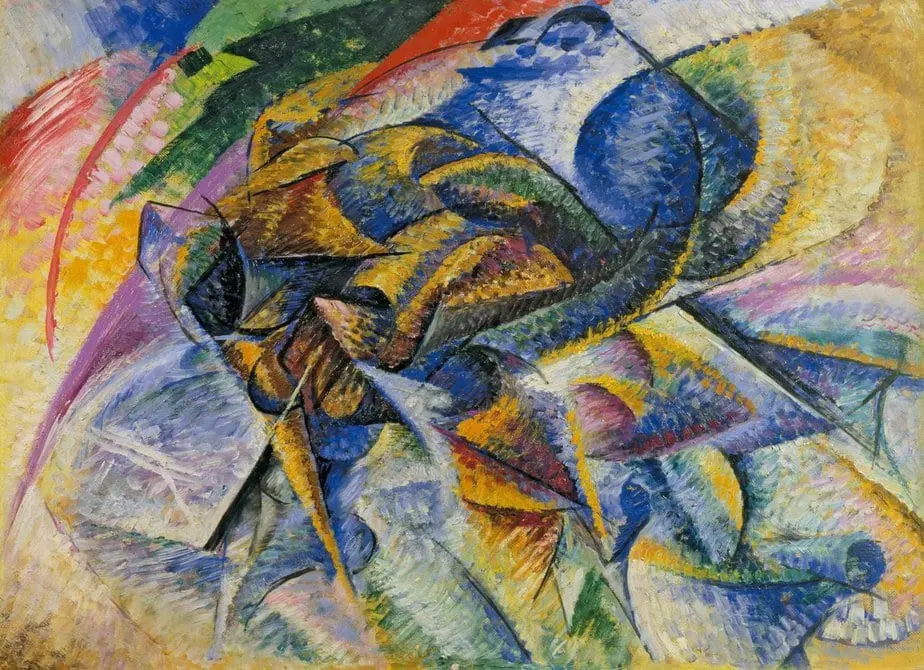
The movement’s visual style was characterized by a focus on "dynamism," which meant depicting objects in motion rather than as static entities. Artists used techniques such as "force lines" to show the direction of movement and "simultaneity" to represent multiple viewpoints or moments in time within a single frame. This approach aimed to overwhelm the viewer’s senses, mirroring the chaotic pace of the new machine age.
- Rejection of historical art and academic traditions.
- Glorification of technological progress and industrial machinery.
- Emphasis on speed, noise, and urban energy.
- Use of vibrant, aggressive color palettes.
- Integration of political activism with artistic expression.
Who were the key Futurist artists?
While Marinetti provided the ideological framework, several painters and sculptors translated these ideas into visual form. Umberto Boccioni is widely considered the movement's most talented artist, famous for his ability to merge human figures with their surrounding environments. His sculpture Unique Forms of Continuity in Space remains the definitive example of capturing motion in bronze. Giacomo Balla, another central figure, focused on the scientific analysis of light and movement, often painting subjects like running dogs or speeding automobiles.
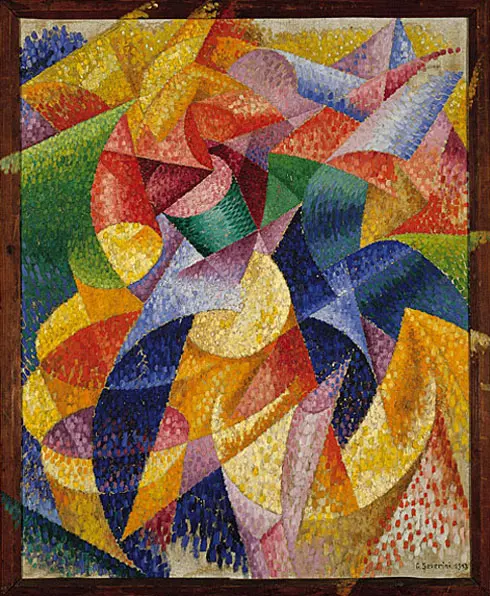
Other notable contributors included Carlo Carrà, Gino Severini, and Luigi Russolo. Russolo was particularly innovative, expanding the movement's scope from visual arts to music by inventing "noise-intoners" (intonarumori), which were machines designed to replicate the sounds of the industrial world. Despite their diverse approaches, these artists were united by a shared belief that art should evolve alongside scientific breakthroughs. Their collaboration created a cohesive, albeit short-lived, aesthetic that pushed the boundaries of traditional painting and sculpture.
How did Futurism impact modern design?
Futurism’s influence extended far beyond the canvas, fundamentally altering the trajectory of modern graphic design, architecture, and typography. By breaking free from the constraints of traditional composition, Futurist artists experimented with "words-in-freedom," a technique that treated text as a visual element. They rejected standard punctuation and grammar, arranging letters in varying sizes and directions to create a sense of auditory impact on the page. This approach laid the groundwork for modern advertising and avant-garde typography.
In architecture, Antonio Sant’Elia envisioned a city of the future characterized by massive, multi-level structures, elevators, and power stations. Although few of his designs were built, his sketches inspired generations of architects to embrace industrial materials like glass, steel, and concrete. The movement’s obsession with efficiency and functionalism prefigured the Bauhaus school and the International Style of the mid-20th century.
- Study the use of "force lines" in Boccioni’s paintings to see how motion is suggested.
- Examine Futurist posters to understand how typography was used to convey kinetic energy.
- Compare early 20th-century industrial photography with Futurist paintings to identify shared visual motifs.
- Research how the movement influenced later graphic design trends in the 1920s.
What were the movement's political associations?
The political trajectory of Futurism remains its most controversial aspect. Many Futurists were fervent nationalists who viewed war as the "world’s only hygiene," believing that conflict would cleanse Italy of its stagnant, archaic traditions. This aggressive stance led many members to support the rise of Italian Fascism in the 1920s. Marinetti, in particular, aligned himself with Benito Mussolini, viewing the Fascist regime as an extension of the Futurist desire for a powerful, modernized state.
This political entanglement caused a rift within the movement and eventually led to its decline. As the regime consolidated power, it shifted its preference toward more traditional, state-sanctioned art, often sidelining the more radical experimentalists. By the late 1930s, the movement had largely lost its revolutionary fervor, becoming a tool for propaganda. Understanding this history is essential for a complete view of the movement, as it highlights the dangerous intersection between radical aesthetic theory and extremist political ideology.
Common mistakes when studying Futurism
A frequent error is assuming that Futurism was solely a painting movement. In reality, it was a totalizing philosophy that encompassed performance art, fashion, cooking, and music. Another common mistake is conflating Futurism with Cubism. While both movements utilized fragmented planes, Cubism was primarily concerned with the analytical deconstruction of objects from multiple perspectives, whereas Futurism focused on the emotional and kinetic experience of time and speed.
Avoid viewing the movement through a purely aesthetic lens without considering its historical context. The Futurist obsession with violence and war was not merely a metaphor; it was a genuine, albeit misguided, belief in the necessity of destruction for progress. When analyzing Futurist works, always look for the underlying motivation: is the artist attempting to represent an object, or are they attempting to represent the sensation of that object moving through space? Distinguishing between these two goals is the key to understanding the movement's core contribution to art history.
Key facts
- Futurism originated in Italy in 1909 with the publication of Filippo Tommaso Marinetti’s "Futurist Manifesto" in the French newspaper Le Figaro.
- The movement glorified modernity, speed, technology, youth, violence, and the industrial city as the primary subjects of artistic expression.
- Artists used "dynamism" and "lines of force" to represent movement and the passage of time within a single, static two-dimensional image.
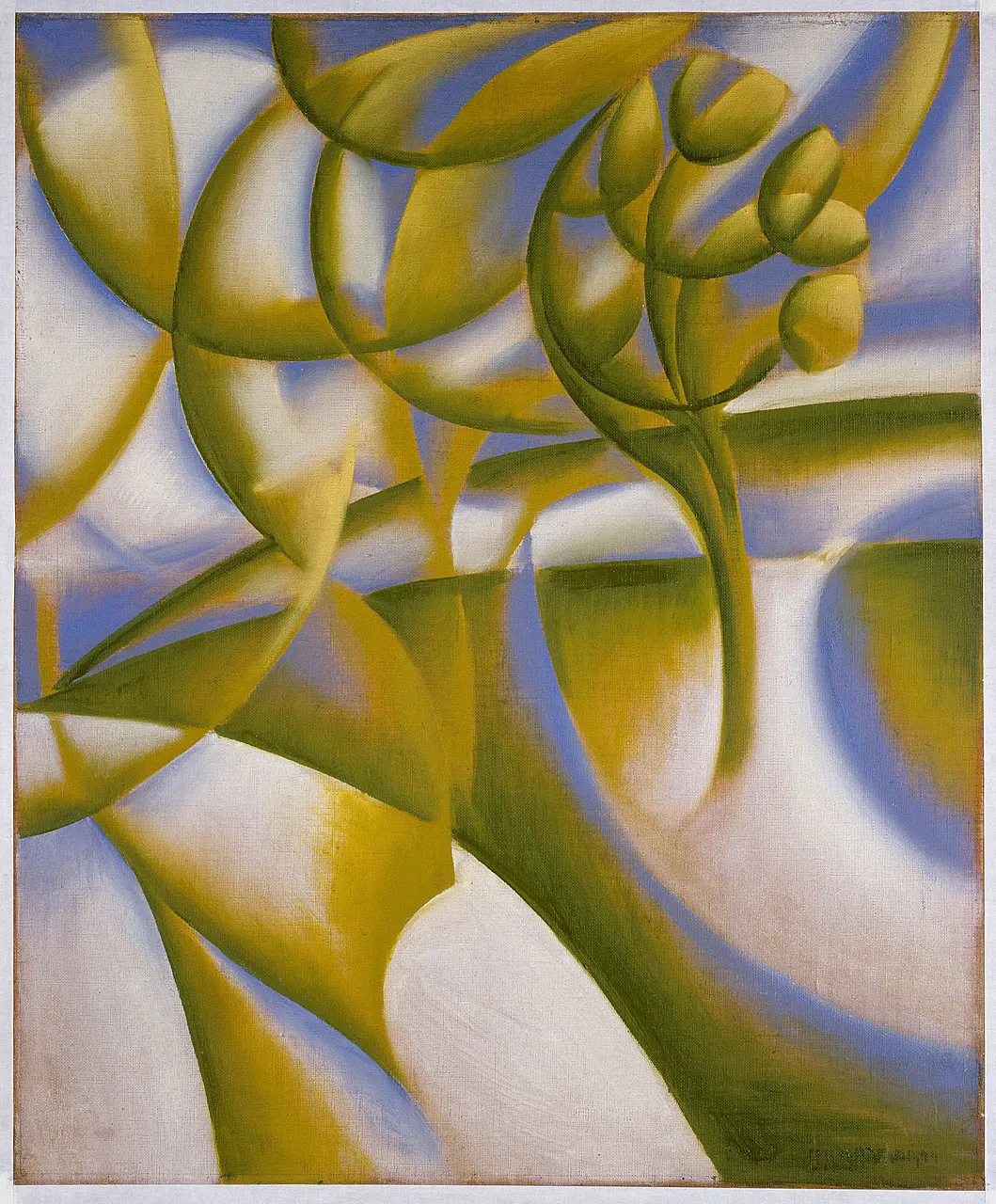
- Common visual techniques included fragmented forms, overlapping planes, and blurred outlines to simulate the sensory experience of rapid motion.
- Key figures in the movement included painters Umberto Boccioni, Giacomo Balla, and Gino Severini, and the architect Antonio Sant'Elia.
- To practice Futurist art, focus on depicting a single object in multiple stages of motion simultaneously rather than capturing a frozen, realistic moment.
The bottom line
Futurism was a radical early 20th-century movement that rejected historical tradition in favor of the exhilarating speed and power of the machine age. By utilizing fragmented forms and dynamic lines, artists attempted to capture the sensory intensity of modern life. While politically complicated, its bold aesthetic innovations fundamentally altered the trajectory of modern art, encouraging creators to embrace change, technology, and the relentless momentum of progress.
People also ask
How does Futurism differ from Cubism?
While both movements used fragmented geometric forms, Cubism focused on analyzing objects from multiple viewpoints in a static space. Futurism, by contrast, sought to represent the energy, rhythm, and speed of the modern world.
What is the significance of the "Manifesto of Futurist Painting"?
Published in 1910, this document formally rejected traditional academic art and museums. It urged artists to embrace the "universal dynamism" of contemporary life and to paint the sensations of the modern era.
Did Futurism influence other art movements?
Yes, it significantly impacted Vorticism in Britain, Constructivism in Russia, and Precisionism in the United States. Its emphasis on mechanical aesthetics paved the way for later developments in kinetic and performance art.
Why is Futurism often associated with political controversy?
Many early Futurists, including Marinetti, were fervent nationalists who supported Italian intervention in World War I. Their rhetoric often aligned with the rise of Italian Fascism, leading to a complex historical legacy.
What are the common mistakes when trying to create Futurist art?
A major mistake is focusing too much on static, symmetric composition. To capture the Futurist spirit, you must prioritize asymmetrical balance, diagonal lines, and the visual distortion of objects to suggest velocity.
Is Futurism limited to painting and sculpture?
No, the movement spanned various disciplines including architecture, literature, music, fashion, and film. Futurists aimed to create a "total work of art" that integrated all aspects of modern life into a single aesthetic vision.
This answer was created with the help of AI research tools and reference sources. Spotted an error? Let us know — we correct mistakes quickly. See our editorial policy.