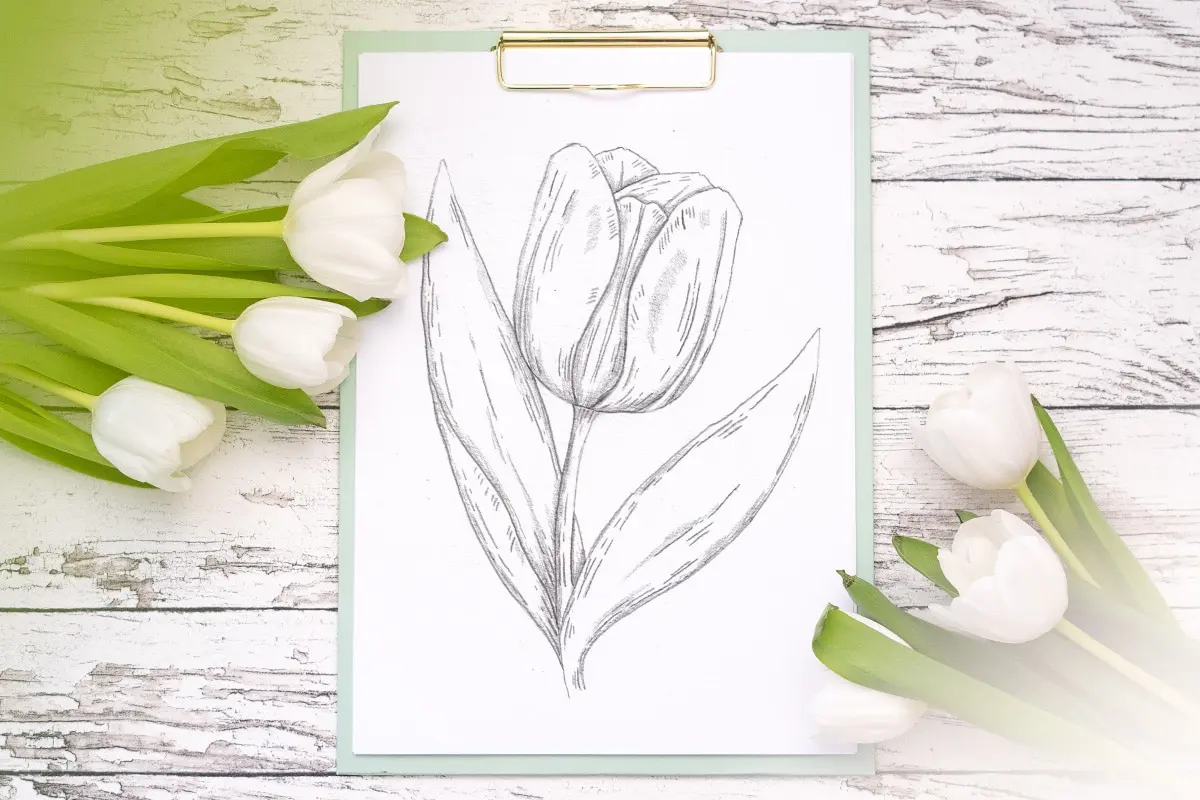
How can I draw a field of flowers easily?
Short answer
Drawing a field of flowers is best achieved by establishing a horizon line, using varied shapes for depth, and layering colors. By focusing on simple geometric forms for foreground blooms and abstract textures for the distance, you can create a professional-looking landscape without needing to draw every individual petal or stem.
On this page
How to sketch a field of flowers for beginners
The most effective way to start a field of flowers is by establishing your composition through a horizon line. Placing this line lower on the page emphasizes the vastness of the sky, while a higher line focuses the viewer’s attention on the density of the blossoms. Begin by lightly sketching the general shapes of flower clusters rather than individual stems to avoid cluttering your page.
Once the layout is set, use simple shapes to represent different flower types. Circles, ovals, and small triangles serve as excellent placeholders for daisies, tulips, or poppies. By varying the size of these shapes, you create a natural sense of perspective where larger, more detailed flowers appear closer to the viewer. This foundational step ensures your drawing has structure before you begin adding color or intricate details.
Best tools for drawing floral landscapes
For those just starting, a combination of graphite pencils and watercolor pencils offers the most versatility. Graphite allows you to map out your composition without leaving harsh lines, while watercolor pencils provide a soft, painterly effect that mimics the organic nature of a meadow. If you prefer a more graphic style, fine-tip pigment liners are ideal for adding crisp, clean edges to your foreground flowers.
When selecting your color palette, stick to a limited range of hues to keep the scene cohesive. A common technique involves using warm tones like yellow, orange, and red for the primary flowers, while utilizing cool greens and blues for the foliage and background. Consider these essential items for your kit:
- HB or 2B graphite pencils for sketching
- A kneaded eraser to lift pigment without damaging the paper
- High-quality cold-press watercolor paper for texture
- A set of 12-24 colored pencils or watercolor pans
How to create depth in a flower field
Creating the illusion of depth is what separates a flat drawing from a professional landscape. The key is to use the principle of atmospheric perspective, which dictates that objects further away should be less detailed and slightly lighter in color. In the foreground, draw distinct, well-defined flower heads with visible petals and stems. As you move toward the horizon, transition to soft, blurry patches of color.
You can also use overlapping techniques to enhance the sense of space. By drawing some flowers slightly in front of others, you force the eye to perceive layers within the meadow. Follow these steps to build your field:
- Draw the largest, most detailed flowers at the bottom of the page.
- Fill the mid-ground with medium-sized clusters, leaving small gaps for stems.
- Use light, horizontal strokes or dots to suggest distant flowers near the horizon.
- Add shadows beneath the foreground flowers to anchor them to the ground.
Why perspective matters in landscape drawing
Perspective provides the necessary context for the viewer to understand the scale of your field. Without a clear vanishing point or a sense of receding ground, your flowers may appear as if they are floating in space. Even in a simple drawing, ensure that the stems of your flowers appear to grow from a single ground plane. This consistency makes the scene feel grounded and realistic.
Another factor to consider is the density of your flowers. In nature, a field of flowers is rarely uniform; there are patches of thick growth and areas of sparse grass. By grouping your flowers into clusters rather than spreading them evenly across the page, you mimic the natural growth patterns of wild meadows. This irregularity is exactly what makes a landscape look authentic and visually interesting to the human eye.
Common mistakes when drawing flowers
One of the most frequent errors is attempting to draw every single flower in the field with equal detail. This approach leads to a busy, overwhelming composition that lacks a clear focal point. Instead, focus your energy on the foreground and allow the background to remain abstract. Remember that the human eye naturally focuses on what is closest, so let the distant flowers remain suggestions of color and shape.
Another common mistake is neglecting the foliage. A field of flowers is supported by a foundation of grass, leaves, and stems, which provide essential contrast to the bright colors of the petals. Failing to include these greens makes the flowers look like they are sitting on top of the ground rather than growing from it. Always remember to:
- Avoid drawing perfectly straight, vertical stems, as real plants curve and bend.
- Refrain from using harsh black outlines for everything, as this flattens your image.
- Ensure your light source is consistent so that shadows fall in the same direction for all flowers.
Key facts
- Use the rule of thirds to place your horizon line either one-third from the top or bottom of the page.
- Draw larger, more detailed flowers in the foreground and smaller, simpler shapes as you move toward the horizon.
- Apply atmospheric perspective by using cooler, lighter colors for distant flowers and warmer, bolder colors for those closest to you.
- Group flowers in clusters of three or five to create a natural, organic appearance rather than a rigid grid.
- Vary the heights of your flower stems to prevent the field from looking like a flat, uniform carpet.
- Leave small gaps between flower heads to suggest depth and allow the viewer's eye to travel through the scene.
The bottom line
Drawing a field of flowers is best achieved by prioritizing depth over intricate detail. By using larger, warmer shapes in the foreground and smaller, cooler shapes near the horizon, you create a realistic sense of space. Remember to cluster your flowers in odd numbers and ensure they are anchored to the ground to avoid a floating effect. Consistency in your technique will yield a beautiful, professional-looking landscape.
People also ask
How do I make the flowers look like they are in a field?
Focus on overlapping your shapes so that some flowers appear to be behind others. This layering technique creates the illusion of a dense, three-dimensional space rather than just a collection of individual plants.
What is the best way to draw a flower shape quickly?
Use simple marks like dots, small circles, or "V" shapes to represent distant blooms. You do not need to draw every petal; suggesting the texture is more effective for a large field.
Should I draw the ground before the flowers?
Yes, sketch the general shape of the terrain first to establish the perspective. This provides a guide for where to place your flowers so they follow the contour of the land.
How do I choose a color palette for a flower field?
Limit your palette to three or four primary colors to keep the composition cohesive. Use complementary colors for the background to make the foreground flowers pop.
Why do my flowers look like they are floating?
You likely forgot to anchor the stems to the ground line. Ensure that every flower stem visually connects to the base of the field or disappears behind another flower.
How can I create a sense of movement in the field?
Tilt the stems of your flowers in the same direction to suggest a gentle breeze. Adding a few curved lines can also imply the wind blowing through the petals.
This answer was created with the help of AI research tools and reference sources. Spotted an error? Let us know — we correct mistakes quickly. See our editorial policy.